Ugly anti-papal protests are harming the so-called secularist cause
Protesting about the Pope coming to your city is appalling bad manners
By FR ALEXANDER LUCIE-SMITH on Wednesday, 24 August 2011
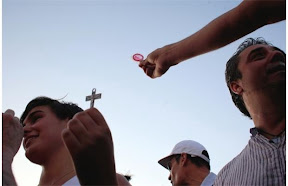
A World Youth Day pilgrim walks past protesters in Madrid's Puerta del Sol square (AP Photo/Emilio Morenatti)
I had dinner last night with an enthusiastic returnee from World Youth Day, which has received ample coverage from many media outlets, with a few all too predictable exceptions. I asked whether he had seen any of the anti-Pope protesters, and he said he had not – which is hardly suprising, given that the people at World Youth Day outnumbered the protesters by about a thousand to one.
And what were they protesting about? It seems the cost. But, as this article from the New York Times shows, WYD will actually benefit the Spanish economy. Besides which, since when did protesters actually protest anywhere about government spending? Forgive me if I doubt their sincerity.
It seems we must get used to the idea that wherever the Holy Father goes the usual suspects will round themselves up and stage a protest, indulging their love for synthetic rage. First London, now Madrid…
But just think about it for a minute. These people do not like the Pope and they do not agree with his teachings. Well, I feel no real empathy with Buddhism, and I strongly disagree with Buddhist teaching on reincarnation. So, whenever the Dalai Lama rolls into town, should I organise a protest? Of course not! And why not? Because I believe in freedom of conscience, and I fully respect the absolute right of the Dalai Lama to believe what he chooses and to teach what he believes. End of. And I also believe that people who want to hang out with the Dalai Lama have an absolute right to do so, part of their basic human right to freedom of association.
It is this freedom of association, and the freedom of expression that goes with it, that contemporary secularists simply do not “get”. Dr Evan Harris’s secular manifesto makes no mention of these rights, but seemingly sees religion as something relegated to the private sphere alone, as it was in the Soviet Union: “None of it [the manifesto] engages with what families get up to in their home, or religious leaders within their own families.” And yet, ironically, freedom of association and freedom of expression are secular values.
And herein lies the problem: our modern secularists are not really secular enough; they are simply people who dislike religion and want it out of the way. A true secularist would welcome the Pope to Madrid, acknowledging his right and the right of his fellow Catholics to do as they please in conscience and within the bounds of the law, a right they share with everyone else.
If none of this cuts any ice, perhaps I could introduce another idea. Protesting about the Pope coming to your city (if indeed these protesters were Madrileños) is simply rude, a case of appalling bad manners. It is against all the rules of hospitality. Last year we had the King of Saudi Arabia here in London as a guest of the Queen. I can’t honestly say I warm to King Abdullah, or that I approve of his government and its policies, but if I had met him I would have been polite, greeted him as protocol demands, and wished him well. That is what civility demands. Civility: another great secular value. The expressions of infantile rage that we saw when the Pope came here were in fact very damaging to the so-called secular movement, and revealed the forces of anti-religion for what they were. We need to reclaim the word “secular” for proper use, and we need to stop using it to mask the ugly face of anti-religious prejudice.
- Posted using BlogPress from my iPad
MADRID WYD 2011

Thursday, August 25, 2011

Pilgrims vs Protestors #wyd #madrid11
A protester (R) shows a pilgrim a condom who in turn shows him a cross during a demonstration against what they claim is the expensive cost of the papal visit in central Madrid coinciding with the second day of the World Youth Day meeting August 17, 2011. Pope Benedict arrives in Spain on Thursday for a four-day visit to a traditionally Catholic country that has become highly secular.
Photograph by: SUSANA VERA, REUTERS
- Posted using BlogPress from my iPad
Photograph by: SUSANA VERA, REUTERS
- Posted using BlogPress from my iPad
'Spiritual Communion': Youths learn a traditional concept the hard way #wyd #madrid11
VATICAN LETTER Aug-24-2011 (880 words) Backgrounder. With photo posted Aug. 22. xxxi
'Spiritual Communion': Youths learn a traditional concept the hard way
A priest distributes Communion to pilgrims during the closing Mass of World Youth Day celebrated by Pope Benedict XVI at Cuatro Vientos airfield in Madrid Aug. 21. Because of logistical problems, only 100,000 of the more than a million pilgrims at the Mass were able to receive Communion. (CNS/Paul Haring)
By Cindy Wooden
Catholic News Service
VATICAN CITY (CNS) -- More than a million young Catholics learned the hard way about a venerable Catholic tradition: "spiritual Communion" or the "Communion of desire."
After a wild storm Aug. 20 at World Youth Day in Madrid left six people injured -- including two with broken legs -- Spanish police collapsed the tents where most of the unconsecrated hosts for the next morning's Mass were being kept.
Without the hosts in the tents, organizers had 5,000 ciboriums holding 200 hosts each; they were consecrated by the pope at Mass Aug. 21 and distributed to pilgrims in the section closest to the altar.
Distributing Communion to just 100,000 people wasn't a decision anyone took lightly, and apparently there were long discussions with World Youth Day organizers and Vatican officials trying to find a solution. In the end, it just wasn't possible logistically to locate another 1.5 million hosts.
A couple of hours before the Mass, organizers announced that most of the people present would not be able to receive; they asked the pilgrims to offer up that sacrifice for the pope's intentions and told them they could receive Communion later in the day at any church in Madrid.
The decision to cancel Communion for most Mass participants was reached "with the greatest pain," Yago de la Cierva, director of World Youth Day Madrid, told reporters Aug. 21.
Whenever there is a huge crowd for a Mass, whether in St. Peter's Square or at a World Youth Day, there always are some people unable to get to the Communion distribution point in time to receive. But in Madrid, de la Cierva said, "almost everyone" was among those not receiving.
Obviously, receiving Communion is the way to participate most fully in the Mass, but it's not always possible for everyone to receive at every Mass, nor do many Catholics in the world even have regular access to Mass.
The idea of "spiritual Communion" -- inviting Jesus into one's heart and soul when receiving the actual sacrament isn't possible -- is part of Catholic tradition.
In the 1700s, St. Alphonsus Liguori wrote a special prayer for spiritual communion: "My Jesus, I believe you are really here in the Blessed Sacrament. I love you more than anything in the world, and I hunger to receive you. But since I cannot receive Communion at this moment, feed my soul at least spiritually. I unite myself to you now as I do when I actually receive you."
Jesuit Father Federico Lombardi, Vatican spokesman, said it would be a huge mistake to believe the Mass had no value for those who were unable to receive Communion.
"Communion is always an extraordinary gift, and one must be in awe of being able to receive it," he told Catholic News Service Aug. 24.
"It is not something one can presume to have an absolute right to as if he'd bought a ticket for it by going to Mass. Someone who thinks that hasn't understood who is in the consecrated host and what the Mass is," the spokesman said.
The eucharistic adoration and benediction at the vigil in Madrid underlined that point, he said. Jesus is present in the Eucharist, which is why it is adored and why Catholics spend time in its presence, even outside of Mass.
The "eucharistic fasting" many of the young pilgrims in Madrid were forced to endure could also help them be in spiritual solidarity with other people who find themselves desiring the Eucharist, but unable to receive it, he said.
"I'm thinking of Catholics deprived of priests in many parts of the world for many reasons," he said, but there also are those "who would like to celebrate the Lord's Supper with other Christians, but don't have intercommunion out of respect for the norms of the church. Isn't it meaningful in these situations to know we can unite ourselves with Christ through love and desire?"
In an era when people are encouraged to receive the sacrament frequently, they don't hear the term "spiritual Communion" very often, but it is still mentioned in church documents.
The Vatican's preparatory document for the 2012 International Eucharistic Congress in Dublin said those who cannot receive the Eucharist can have spiritual Communion, declaring their desire to receiving the Eucharist and uniting "their suffering of that moment with the sacrifice of Jesus Christ."
The working document for the Synod of Bishops on the Eucharist in 2005 addressed the idea of offering up the sacrifice of being unable to receive Communion. It said: "Spiritual Communion, for example, is always possible for elderly persons and the sick who cannot go to church. In manifesting their love for the Eucharist, they participate in the communion of saints with great spiritual benefit for themselves and the church. By offering their sufferings to God, the church is enriched."
In "Sacramentum Caritatis," the document he issued in 2007 reflecting on the synod, Pope Benedict cautioned people against thinking they had "a right or even an obligation" to receive the Eucharist every time they went to Mass.
"Even in cases where it is not possible to receive sacramental Communion, participation at Mass remains necessary, important, meaningful and fruitful. In such circumstances it is beneficial to cultivate a desire for full union with Christ through the practice of spiritual communion," Pope Benedict wrote.
END
Copyright (c) 2011 Catholic News Service/USCCB. All rights reserved.
This material may not be published, broadcast, rewritten or otherwise distributed.
CNS · 3211 Fourth St NE · Washington DC 20017 · 202.541.3250
- Posted using BlogPress from my iPad
Wednesday, August 17, 2011
Update : Repost - Question for the Pope at #madrid11 #wyd @wydenglish
During the WYD, I posted this, and got a few questions in reply . Perhaps I will try and tackle the questions based on my view and opinion another day.
If you have 1 question to ask the Pope, head of the Catholic Churc, Vicar of Christ.
What would that question be ?
( no i do not have an audience with the Pope! But hypothetically speaking....)
Here were some questions posted by my Twitter followers :
@lkclee Christine: why are you reverting to traditional music in church?
@lkclee Adrian: They r gonna revert to the old Mass rituals. Why are we going backwards in ritual?
@lkclee My Q: Reflecting on 2day's gospel, is there no salvation for those admitted 2 the banquet but banished cos of insufficient grace?
@lkclee XXX : Can you please ask the pope to pray for me ?(summarized and names removed)
- Posted using BlogPress from my iPad
If you have 1 question to ask the Pope, head of the Catholic Churc, Vicar of Christ.
What would that question be ?
( no i do not have an audience with the Pope! But hypothetically speaking....)
Here were some questions posted by my Twitter followers :
@lkclee Christine: why are you reverting to traditional music in church?
@lkclee Adrian: They r gonna revert to the old Mass rituals. Why are we going backwards in ritual?
@lkclee My Q: Reflecting on 2day's gospel, is there no salvation for those admitted 2 the banquet but banished cos of insufficient grace?
@lkclee XXX : Can you please ask the pope to pray for me ?(summarized and names removed)
- Posted using BlogPress from my iPad
SFX Pilgrims singing in thr streets
One of my adopted groups, SFX Pilgrims chilling out under the shade and singing
- Posted using BlogPress from my iPad
- Posted using BlogPress from my iPad
Catechesis on the streets of @wydenglish @madrid11_en
Yesterday's catechesis at love and life centre was full and we couldn't go in. So the diocese of Chicago, decided to hold a session on the street. From the oirginal Chicago group' it swelled with pilgrims from Malaysia, New York , Washington, etc
Will post up more details of the catechesis soon. Running out for my 3rd day
- Posted using BlogPress from my iPad
Will post up more details of the catechesis soon. Running out for my 3rd day
- Posted using BlogPress from my iPad
Subscribe to:
Posts (Atom)